


Treating an illness after it has begun is like suppressing revolt after it has broken out. If someone digs a well only when thirsty, or forges weapons only after becoming engaged in battle, one cannot help but ask: Aren’t these actions too late?
Huang Di (The Yellow Emperor)

The Classic of Medicine
Topic: Self-Cultivation & Health
In the old days the sages treated disease by preventing illness before it began, just as a good government or emperor was able to take the necessary steps to avert war. Treating an illness after it has begun is like suppressing revolt after it has broken out. If someone digs a well only when thirsty, or forges weapons only after becoming engaged in battle, one cannot help but ask: Aren’t these actions too late?
Huang Di (黃帝), usually known in English as the Yellow Emperor or Yellow Thearch, is a legendary sovereign, culture hero, and sacred ancestral figure of ancient China. Because Huang Di belongs to the borderland between mythology, religious tradition, and remembered history, no historically verifiable birth or death date is known. Later traditions placed Huang Di in the third millennium BCE, commonly dating the beginning of his reign to 2698 or 2697 BCE and assigning him a reign of about one hundred years. Tradition identifies Xinzheng, in present-day Henan Province, China, as Huang Di’s birthplace; the third day of the third lunar month continues to be observed there as his traditional birthday. Huang Di is counted among the legendary Five Emperors and came to be regarded as an ancestral founder of Chinese civilization. The earliest surviving evidence for Huang Di, however, comes many centuries after his traditionally assigned lifetime, and scholars therefore regard him as a legendary rather than securely historical ruler.
Chinese tradition remembers Huang Di as a ruler who helped bring order, knowledge, and practical arts to human society. Many accomplishments came to be associated with Huang Di and his court, including developments in government, the calendar, medicine, dwellings, transportation, music, and other technologies. These traditions should not be understood as evidence that a single historical individual invented all these things. Rather, Huang Di gradually became a figure through whom generations of Chinese thinkers expressed ideas about the origins of civilization and well-ordered human life. By the Warring States period (c. 475–221 BCE) and early Han dynasty, Huang Di had acquired important political, cosmological, and religious meanings. Huang Di was associated with the color yellow, the earth phase within the Five Phases system, and the center, and was revered both as an exemplary ruler and a divine or cosmic figure. Early Han rulers also offered sacrifices to Huang Di, showing that Huang Di’s significance extended beyond stories of an ancient king into religious practice.
Huang Di’s enduring importance is especially evident in the body of wisdom attributed to Huang Di. The Huangdi Neijing (Yellow Emperor’s Inner Classic), one of the foundational works of Chinese medicine, presents medical and philosophical teachings through dialogues associated with Huang Di and learned advisers such as Qibo. Modern scholarship does not regard Huang Di as the historical author of this work; its materials developed much later, with substantial roots in the Warring States and subsequent periods. Yet placing these teachings under Huang Di’s name gave them the authority of an idealized ancient source of wisdom. Across more than two millennia, Huang Di came to represent more than a legendary ruler: a cultural image of the wise sovereign seeking knowledge about the human body, society, nature, and the larger order in which human life participates. This evolving legacy helps explain why Huang Di remains important in Chinese medicine, religious tradition, cultural memory, and reflection on the origins of Chinese civilization.
The Yellow Emperor's Classic of Medicine
Ni, Maoshing, translator. The Yellow Emperor's Classic of Medicine: a New Translation of the Neijing Suwen with Commentary. Shambhala, 1995, [Chapter 2,The Art of Life Through the Seasons].
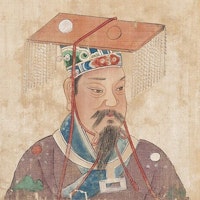
Huang Di (The Yellow Emperor)
Theme: Healing
About This Huang Di [the Yellow Emperor] Quotation [Commentary]
Huang Di’s teaching begins with the sages who treated disease by “preventing illness before it began.” Healing begins with caring for health before suffering becomes established. Huang Di connects this care with wise governance, where necessary steps are taken to “avert war” rather than waiting for conflict. In both, attention is given early, while there is still an opportunity to preserve health and order.
“Treating an illness after it has begun,” Huang Di says, “is like suppressing revolt after it has broken out.” The comparison makes clear what is lost through delay. The teaching does not dismiss treatment once illness appears; it asks us to recognize that care can begin much earlier. Attending to the body, our way of life, and the conditions that sustain well-being may help prevent illness from becoming firmly established.
Huang Di brings the teaching into everyday life through two direct images: someone who “digs a well only when thirsty” or “forges weapons only after becoming engaged in battle.” Waiting until the need is urgent leaves fewer possibilities for responding well. His closing question, “Aren’t these actions too late?” invites us to consider how we care for life before difficulty becomes a crisis. Huang Di places prevention within healing itself: caring for health means paying attention and acting while health can still be protected.
Huang Di, the Yellow Emperor, the Neijing Suwen
The Essential Text of Chinese Health and Healing is written in the form of a dialog between Huang Di, the Yellow Emperor, and his acupuncturist, Qi Bo.
The Yellow Emperor’s Classic of Medicine
Why did scientific and industrial revolutions not occur in China, despite many advances prior to those of the West? One of the key reasons is that Chinese science and technology always
functioned within a philosophy that recognized the importance of balance and harmony between human beings and the environment.
Without sensitive regard to the larger scheme of the universal law, modern science and technology will continue to produce, as part of its welcome advances, disturbances to all life on earth. In the modern age the East can offer the West a philosophy of balance and harmony that is urgently needed, even necessary, for the survival of human civilization. No other Chinese source of this wisdom is as complete as the Yellow Emperor’s Classic of Medicine, or the Neijing.
The authorship of the monumental classic was attributed to the great Huang Di, the Yellow Emperor, who reigned during the middle of the third century BC. The Chinese refer to themselves
as the descendants of Huang Di, who is the symbol of the vital spirit of Chinese civilization. The Neijing is actually two works: the Suwen, “Questions of Organic and Fundamental Nature”, and the Lingshu, “Classic of Acupuncture”, a technical book on acupuncture and moxibustion. Historically, the Neijing refers to the Suwen alone.
The Neijing is one of the most important classics of Taoism. First, it gives a holistic picture of human life. It does not separate external changes – geographic, climatic, and seasonal, for instance
– from internal changes such as emotions and our responses to them. It tells how our way of life and our environment affect our health. Without going into detail, the book articulates a treasure
of ancient knowledge concerning the natural way to health, implying that all phenomena of the world stimulate, tonify, subdue, or depress one’s natural life force.
–Maoshing Ni, Translation and Commentary [The Yellow Emperor’s Classic of Medicine: A New Translation of the Neijing Suwen, 1995].
Additional Yellow Emperor Quotes
A Translation Quoted in World Scripture II
Resources
Related Quotes
Copyright © 2017 – 2026 LuminaryQuotes.com About Us